
how to become unmissable
articulating the shape of your career and attracting people who make it happen

How do you define a career? It’s been called a ladder, a lattice, a framework, a track, and a whole host of other synonyms that more or less convey movement from one point to another. But lately, I’ve been thinking of it in thinner slices rather than broad strokes. More specifically, I’ve been thinking about career as a slow and steady process of converting labour into leverage.
I admit that sounds super transactional, and carries with it none of the sense of agency or personal capability that the other words do. But I say “sense” because while all of the other descriptions of career seem propulsive at their core, they are almost all tracks laid down by someone else.
Thinking of a career as labour → leverage simplifies in the way of scales falling from the eyes. You start your career as a price-taker, and work your way up towards becoming a price-maker.
Think of it like this. When you enter the modern market, you accept the terms, culture, expectations and ways of working handed down to you. You don’t really have the agency to demand a perfect working environment. That early on in your career, it’s also very rare that you completely know your tastes and preferences. In the off chance that you did, you likely didn’t have the chips to back them up.
But every job, for better or for worse, is a data-gathering mission. The trajectory of a remarkable career is about shifting your relationship with the market. You start to earn leverage in the form of capital, skill and reputation. You rapidly identify what you gravitate towards and want to bring more of into your life.
At the same time, you build the safety required to see your career as a series of high-stakes experiments. You can afford to take risks, go all-in on something, or prioritise different parts of your life. The blur of your early career sharpens into a deeper understanding of the games you want to play, with whom, and how. Suddenly, the market is not a master, but a counterparty.
This is the ultimate transition in a professional life, in my opinion: moving from doing things by necessity to doing things by choice. In other words, a sophisticated form of play—and I mean play not as the absence of seriousness, but as the highest form of it. As Nietzsche famously said:
A man’s maturity — that is to have rediscovered the seriousness he had as a child at play.
Choice implies an absolute lack of passivity. Careers, when left to float, have a nasty habit of being shaped entirely by external forces. These forces aren’t necessarily always malicious, but they are indifferent. In my experience, the default drift is a siren in the sea: you might have built all the leverage, only to wake up in five years realising you’ve spent it buying a life designed by a consensus of strangers.
To interrupt that drift, you want a deliberate counterweight, a radical act of attention that drags your vague, floating instincts down into the physical world and represents them in a more articulate form.
The method that I’ve found most useful is the career manifesto.
The first iteration of my career manifesto was beautifully naive…
I wrote that first iteration five years ago, on the cusp of COVID-19 when I left a startup plunged into panic by the virus. I was already certain at that point of what I didn’t like, especially in terms of work culture. I was wary of “we are family” company lines, misleading signs of devotion (like how late people stayed up to work), and was learning very quickly how ambiguity could stem from a genuinely complex marker or actually, just a lack of focus. Losing that job was a sudden violent deceleration, but writing that first rather naive draft of my manifesto led me to attempting something I was latently curious about: freelancing.
I found myself trapped in a strange, hyper-focused pocket of existence. My manifesto was the only operating system I had, but with it I began pitching myself as an independent practitioner. While the first role I took out of desperation, I quickly found a few more clients in spaces I was keen to venture into, like travel and design. My own boldness unnerved me when I reached out to my favourite client from my former company, asking if he’d like to go direct and hire me as a content specialist on contract. He said yes, and that was my first taste of the leverage I’d begun building.
As I continued freelancing, my tastes evolved and my understanding of what games I wanted to play sharpened. I next spent four years at a design consultancy, a freelance gig turned full-time. This was a self-aware organisation with incredible levels of taste and craft, and the most agentic people I’d worked with so far. At the time, I was the Chief of Staff: a role of intense coordination as you are the brain, heart, hands, and connective tissue of the org all at once. It’s role that, as I learned quickly, is an engine for absorbing someone else’s problems. And when you are responsible for absorbing problems, it rather makes sense that you believe in them, too.
So when I went back to my manifesto, it was with these factors in mind. I was no longer the desperate price-taker of 2020, and I’d spent four years earning leverage that would, in fact, carry me for a long time into my career. But once you have it, the temptation to squander it on a safe and prestigious equilibrium is immense.
Reopening that document was a confrontation, because the child at play—that Nietzschean metric of maturity—began to poke through the lines. I had my first inkling that I wanted more of the “skin in the game” feeling that came from building things yourself. I was also beginning to understand what domains they might be in, but that sharpened into 4k only earlier last year, in fact.
The current iteration of my career manifesto is an affirmative claim on that future. I will admit something to you: I felt super immodest, even arrogant, writing it. It would’ve horrified my 2020 self with its sheer lack of humility. But to be honest, to have skin in the game, you have to admit you care about the outcome.
I wrote about care as rebellion in:

A manifesto is an act of intense, concentrated attention
It’s a way to “codify a new worldview, culture or system of thought”. To write a manifesto is to take yourself seriously as someone whose life is worth shaping, and to refuse the posture of nonchalance that the culture otherwise rewards. It’s cool to care about things.
In the case of a career, a manifesto is a public or private declaration of what you value, how you intend to operate, and what you refuse to endorse for yourself. It’s not a career plan, which can end up being rigid, fragile, and incorrigibly controlling of the future. It’s not a manifestation, even though they share the same etymological root. They both mean to make the invisible visible. But where a manifestation is a passive and future-facing wish cast out into the universe, a manifesto is an active declaration in the present.
A career manifesto is both a filter and a flare. As a filter, it repels the consensus-good in favour of the personal-great. As a flare, it attracts the rare, specific fits, the Hell Yeah opportunities. Once you’ve said plainly what you want and how you operate, you become findable by the people and situations that fit and—just as usefully—unbearable to the ones that don’t.
To do that, a manifesto has to be defined just as much by what it rejects as by what it desires. It requires an opposition. If your manifesto appeals to everyone, it has no teeth.
What a manifesto can do for you
I think a manifesto is powerful in two distinct phases: first in the privacy of writing it, and then in the vulnerability of releasing it.
Phase 1: The writing
The act of writing a manifesto is, at large, a structural audit of your own mind.
It’s astonishing how many contradictions we can hold in our minds without ever feeling uncomfortable. In the safety of your head, you can gloss over difficult choices and coast on vague intentions. Anything unwritten remains immune to evidence. But a manifesto acts as a forcing function. When you drag those fuzzy, ambient desires out of your thoughts and into a tangible form before your eyes, the fallacies become glaringly obvious. Seeing them in front of you pushes you into a mode of action that keeping them in your head never could.
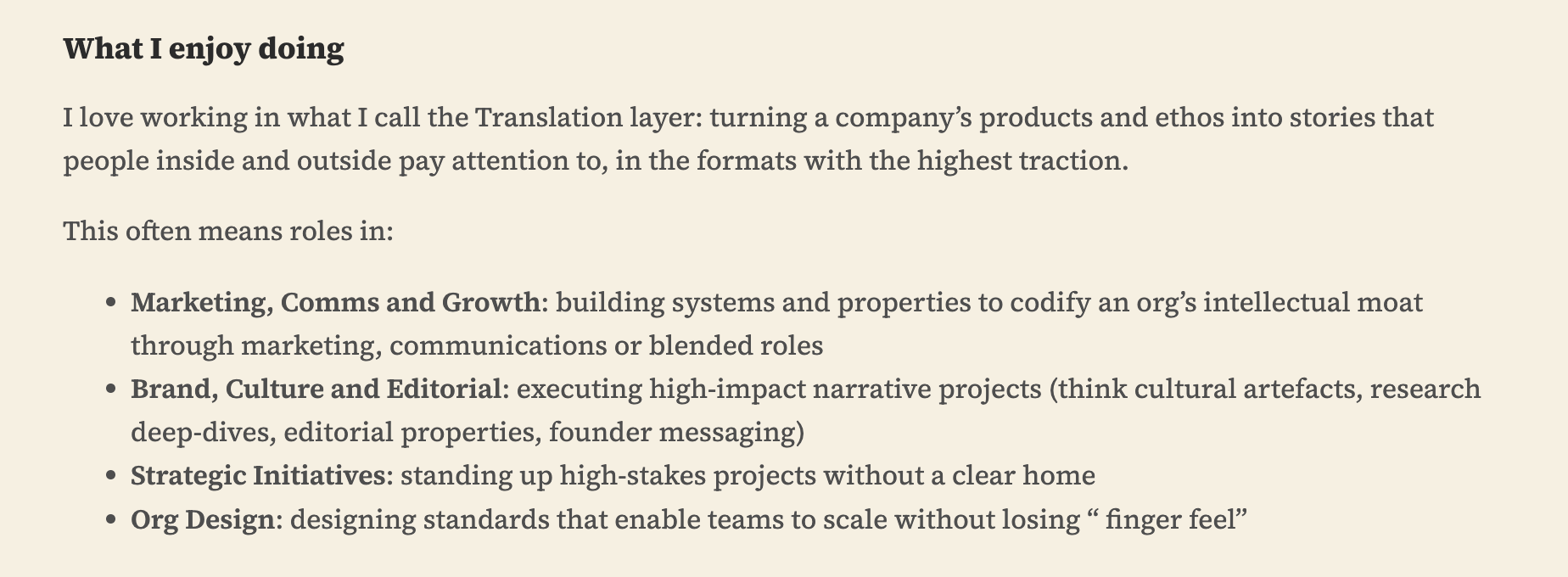
Second, writing a manifesto inoculates you against borrowed wants. Desire is largely mimetic, so if you don’t make a decision on your own, you are likely to absorb goals from whoever is nearest (in skill or aspiration). A manifesto works as armour against ambient pressure, and helps you notice when a want isn’t yours because it doesn’t match what you already wrote.
Third, it helps you arrive at how you would define “good”. We say that a lot: she has a good job, a good career, a good role. Without our own explicitly stated criteria, we naturally tend to evaluate job offers based on legible proxies like title, compensation and logo prestige. Sneakily, these are also the types of jobs a lot of people would congratulate you on taking! And that makes the seams that much harder to spot. So the act of writing a declarative manifesto is what lets you identify, and then turn down, the consensus-good for the personal-great.
Finally, the act of writing a career manifesto lets you define what problems—and whose problems—you want to absorb. Every company sets out to solve a problem they’ve identified as critical. But not all of them need your effort or are right for you.
A person who doesn’t articulate what they want from their career treats every incoming opportunity as an isolated question. They re-litigate every single offer from scratch, under immense pressure, against whatever emotional criteria happens to be loudest in their head at the time.
But by defining your “Hell Yes” in advance, your “Nos” become free. You no longer need to work up a grand philosophical justification every time a misaligned project comes along. You simply check it against the text.
Phase 2: The releasing
A career is formed by a two-way current: what you attract, and what attracts you. A manifesto is in service of the latter, but just as hugely defines much of the former.
Releasing a manifesto radically increases your luck surface area. As I wrote in my essay on identity:
The world has this wonderful way of shifting slightly on its axis to make space for your new dimension.
When you make your standards evident, you go from being a resume in a stack to a beacon whose tastes and parameters are completely legible to the outside world. It changes the gravity around you, this act.
In my experience, a career manifesto also works as a great translator. The people who manage future-thinking companies or run interesting projects are constantly searching for individuals who possess a distinct point of view, because competence is common but alignment is rare. A career manifesto acts as a sort of shortcut for trust, by virtue of just making the person feel, “oh, she speaks my language”.
(The goal is not to close the door on the world so tightly that nothing can get in. It’s to draw boundaries that are precise enough to guide you, but open enough to allow for serendipitous interpretation. This is actually what makes you intensely desirable to the right collaborator: a legible orientation.)
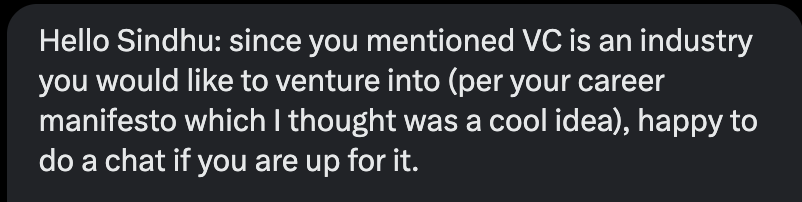
Publicly releasing a manifesto also does one thing which takes longer to come to terms with: it publicly commits you to your own standards. It’s like an external spine, protecting you from shock or moments of weakness or being in two minds about something.
Of course, you don’t always have to publish your manifesto in public. It is, above all, a way to make your orientation, tastes and preferences legible to the most important person in this equation: yourself. But there’s no denying the power of letting it float on the internet, or at the very least the cozy web, to see what it attracts.
Prompts to start writing your career manifesto
I think there are a bunch of different ways you can start writing your manifesto. But ultimately, they should answer these questions, so they’re as good a starting point as any:
What are my refusals?
As I said earlier, a manifesto is equally defined by what it rejects. I find that it’s far easier to outline what you dislike, so that can be a good starting point.
Try your best not to be generic, or state the obvious. If you write "I don't want a toxic workplace," your constraint has no teeth, because nobody is actively looking for toxicity anyway. A real refusal requires a meaningful opposition. You might get further when you write something like “I don’t want to work somewhere that treats late-night Slack pings as a sign of company devotion”.
What are my desires?
Equally, you have to make clear what you do want: the shape of your career, the specific aspects of how you want it to change you, and so on. That might work as a filter, but it won’t work as a flare. It is easy to compile a list of complaints drawing from bad experiences or horror stories from people you know. Like anything with a bit of productive friction, it is much more rewarding to look at a blank page and admit exactly what you want in a way that is both definitive and expansive.
Why this particular sentence or articulation?
There are incredible, almost ridiculous, benefits to simply asking “why” until you hit the ground. Don’t let yourself be satisfied with your first-ever articulation right off the bat. Interrogate it by repeatedly asking yourself, “why?” Why do I want this? Why did I use that word? Why did I explain it like that? Keep going until you run out of Whys.
It’s almost comedically childlike, but that’s the whole point. Eventually you will reach a point where you either know the answer or you don’t. And at that point it’s just not possible to bluff to yourself. And by doing so, you would have reached the absolute bones of that answer, which means you’ve stripped away all the metaphors and blanket terms like “craft” and “ambiguity” to arrive at an articulation that is almost visceral. The more specific your phrasing, the more powerful it is.
Can someone else have written this manifesto?
Ideally, you should be able to answer this question with a Hell No. If the answer is yes, it’s possible that some borrowed wants have leaked onto the page. It’s worth forcing yourself down past what almost everyone shares, to the specific ones that are actually yours.
What does this say about me?
Is your manifesto clear enough to guide you, but expansive enough to let others interpret how your skills apply uniquely to their projects? A manifesto shouldn’t just list what you want to extract from the world; it needs to show how you operate when those conditions are met. It’s important to make sure your manifesto is positioning you as selective but not closed off, generative but not ambiguous, focused but not tunnel-visioned… you get the drift.
Writing a career manifesto, ultimately, is rewarding in the way almost all hard things are. You will inevitably outgrow your first career manifesto, and likely your third and your fifth. But that’s how this works. A manifesto evolves as you evolve. At the very least, it forces you to exercise agency over the one part of your life you will spend the most time living.
Looking forward for a great weekend read xD P.S it’s early in India, do you even sleep 😭
Perhaps becoming unmissable isn't about convincing everyone to notice you. It's about becoming so unmistakably yourself that the people who resonate with your way of seeing the world would feel your absence if you disappeared. Attention is easy to buy. Recognition is much harder.