
every book you read becomes a part of how you see
or, why I read and what reading can do for you, if you let it

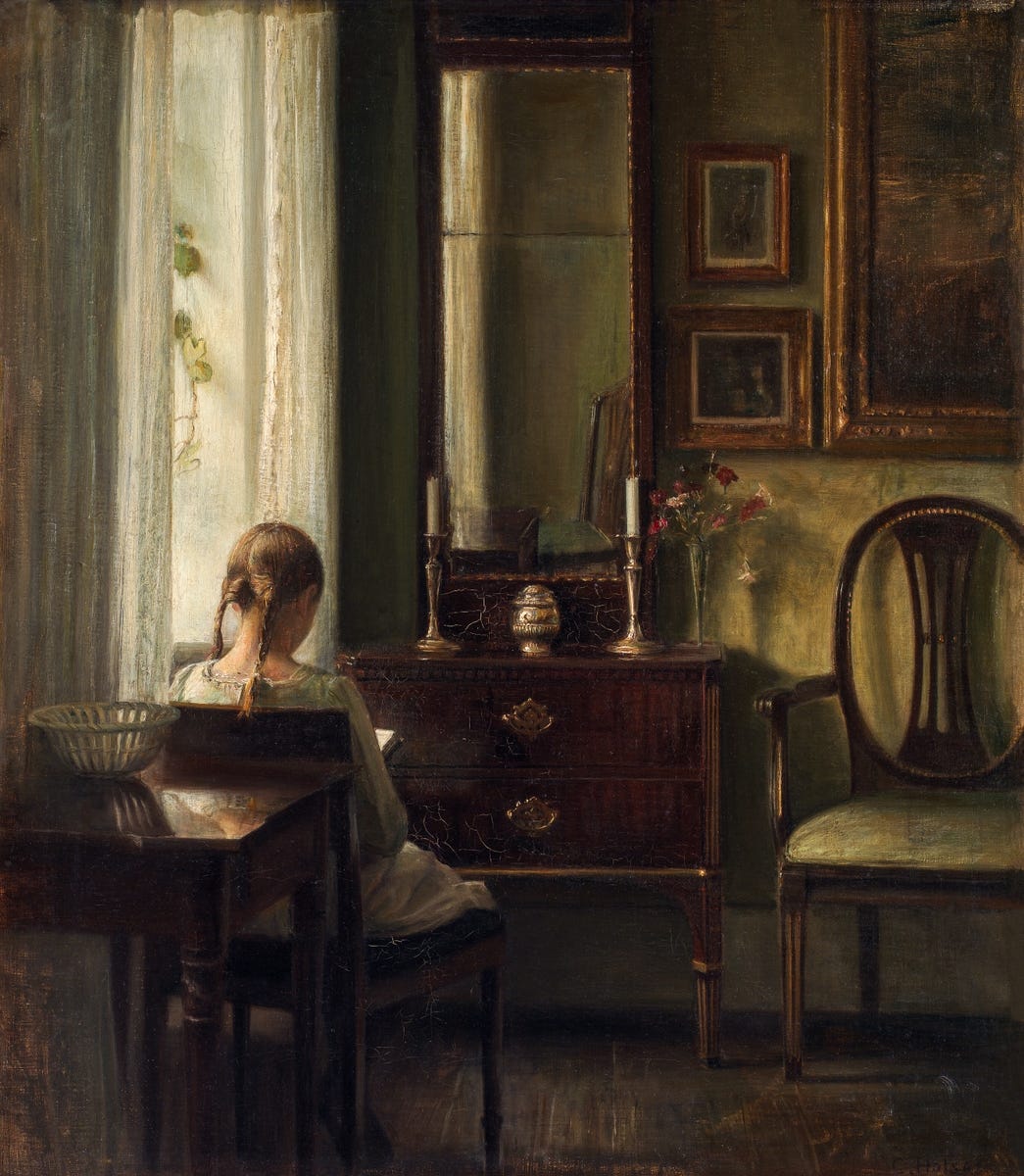
I’ve been reading for almost as long as I’ve been alive, and so asking myself why I read is like asking myself why I breathe. I think I was born to be a reader; there are videos of me as a three-year-old unsticking pages of a well-worn Dr Seuss book with jammy fingers. My mother says that even before I could read, I could “read”: I would memorise entire books that she read to me and narrate them to myself, word for word, when she was busy.
I think that origin story explains the habit, but not the hunger. Now that I think about it, what I was practising was the double-consciousness that reading calls for: the part of you that reads the words and the part of you that listens to them sitting in the same body, keeping each other company. It’s strange and kind of hard to defend, that books have done more to make me feel seen than most people have (I’m still working out whether I need to be embarrassed about this).
There’s a lot on the internet about how to read, but most of it treats reading as an optimisation problem. How to read more books in a year. How to take better notes. How to remember what you read in ways that make you feel incredibly intellectual. Hot girls read, and all that.
Personally, the question I find more interesting is: what can reading do for you, if you let it? A book read at arm’s length will leave you roughly the person you were when you opened it. To get anything else from it, you have to be willing to be rearranged.
While this has probably happened to me more times than I can remember, I do remember one time very clearly.
I was 21, sitting on the cool tile floor of my bedroom in my parents’ house, reading Marilynne Robinson’s Gilead. There is a passage where the narrator, an old pastor writing to his young son, describes a couple he sees walking down the street:
There was a young couple strolling along half a block ahead of me. The sun had come up brilliantly after a heavy rain, and the trees were glistening and very wet. On some impulse, plain exuberance, I suppose, the fellow jumped up and caught hold of a branch, and a storm of luminous water came pouring down on the two of them, and they laughed and took off running, the girl sweeping water off her hair and her dress as if she were a little bit disgusted, but she wasn’t. It was a beautiful thing to see, like something from a myth. I don’t know why I thought of that now, except perhaps because it is easy to believe in such moments that water was made primarily for blessing, and only secondarily for growing vegetables or doing the wash. I wish I had paid more attention to it.
Brilliant sun. Glistening trees. Luminous water. I remember reading the paragraph again, and again, and then putting the book down. I had walked under wet branches my whole life, but I’d never seen it as a benediction until now. I didn’t know this was something a person could notice.
I think good prose is, among other things, proof that the word is more finely textured than your usual attention to it would suggest. Reading becomes your way to perceive that texture for yourself. After Gilead I started seeing benedictions everywhere: in my father making tea for when I returned from work, in my friend absent-mindedly straightening my blouse in the doorway during a house party, in a dog resting her paw on my calf in her sleep. The world hadn’t changed, but for a few weeks after that book, I had Robinson’s eyes. A wonderful kind of dislocation.
Multiply this by hundreds of books over a few decades, and the inside of your head fills up with other people’s noticing. Proust is with you when you pull a cake out of the raging hot oven. Laurie Colwin hands you dish soap at the kitchen sink. Arundhati Roy puts words to the whirlpool of feelings about your mother.
Reading allows you to borrow language for experiences you already had but couldn’t articulate, and articulating experiences is what makes them real. It’s like the more language you absorb, the more the friction between feeling and expression lowers, and lowers, and lowers.
I think this is what I mean when I say: being seen by something you read is often more transformative than being seen by a real person. Finding words in a novel that perfectly describes your experience moves it from a private embarrassment to something that belongs to the world. I find that makes you a little more forgiving of yourself, by pulling your gaze away from your navel to recognise that this shame, hurt, joy or pride is yours, but not only yours.
There’s a line I keep repeating to friends whenever we’re talking about influences: your taste is your biography. Almost everything that shapes us—country, family, century, schooling, DNA—we did not choose. Reading is one of the few levers we have almost complete control over, even if it doesn’t feel that way.
I’ve seen a lot of potential readers get scared off by books they’re supposed to read. Think hefty classics, canons and anti-canons, long- and shortlists for prizes, even top 100 recommendations drawn from data or bias but published with authority. Forget potential readers—I, longtime reader and lover of books, have also spent many hours in Blossom Bookstore agonising between a delicious fantasy and an intellectual anthology with a shiny Booker Prize sticker on it. Virginia Woolf, in How to Read a Book?, nails the questions that come tumbling through our heads when we enter a room filled to bursting with books of all “shapes and sizes and values” and have to choose:
What is the right way to set about it? They are so many and so various. My appetite is so fitful and so capricious. What am I to do to get the utmost possible pleasure out of them? And is it pleasure, or profit, or what is it that I should seek?
Small wonder that we seek the protection and familiarity of a neatly numbered list.
The problem with these lists isn’t that the books on them are bad. Many of them are transformative, honestly, extraordinary. But the problem is they arrive on your screen with a kind of homework smell, and homework is possibly the worst frame for the thing reading actually is. How do you fall in love with someone? You don’t fall in love because they showed up on the Top 100 Most Loveable People Of The Decade list, or you felt like you owed it to them. You fall in love because you sat next to them at dinner one time and they said something that made your mind fall wide open. Books are pretty much the same; they won’t change you if you approach them out of duty or, worse, fear of missing out.
I’d like to offer you a different way to think about taste, as not something you’re handed down and start to consult, but something you build for yourself over time. A biography, like I said. Reading is incredibly helpful here. The first ever serious book I read rewired me a little. The next one rewired me against the grain of the first. After ten or fifteen years of this, I had a sensibility that applied itself to everything else I’ve ever done, like a residue of the reading that has passed through me.
In an older essay, I wrote:
To be able to choose who influences that is both a privilege and a responsibility… When you surround yourself with the right milieu, wondrous things happen.
Reading, too, is a form of milieu curation, but this time not bounded by generation or geography.
I think this is why the question of what to read matters more than you might think. It’s entertainment for a Sunday afternoon, but it’s also the lens you’ll use to perceive everything else for some time. (This is also my answer to people who look down their noses at people who read Maas instead of Chekhov: the person who reads with full attention is building an apparatus, the one who reads Chekhov to impress friends is not. The question is always, always, about the quality of the reading).
This shift is often only apparent in retrospect. You don’t know what books will become load-bearing pillars of your psyche until years later, when the upper layers of the book have vanished into time but its ideas have fundamentally reorganised something for you. You find out what you let in when you’re surprised by how you’ve changed.
I have so much more to say about reading:
The appetite for Being A Reader and the appetite for reading are two different desires, often confused
Reading can often be difficult, and describing it with a blanket word like “escape” is a disservice to yourself and the kind of reading that puts you through the mill, yes, but brings you out completely changed
Reading involves friction, but it’s being slowly engineered out to much loss
The experiences some people chase when they read a book lives on the reader’s side of the page, not in the book itself
All of these deserve their own essays which I’ll get to soon. In the meantime, please share this essay with readers and non-readers, and leave a comment if something resonated.
"The experiences some people chase when they read a book lives on the reader’s side of the page, not in the book itself" is so dear to me as it directly speaks to my process of constructing the world, casting relevant actors for the characters.. so much so that I feel like I'm directing a movie as I read haha xD
On reading before you could 'read'... Scout Finch tracing the words in the newspaper sitting in Atticus's lap.
What I miss most about being a certain age, and immersing myself in a book, is the sense of envelopment, of being in and of the book, rather than a spectator, no matter how keen.